If you have been comparing Charleston's peninsula neighborhoods this year, you have probably run into the number. South of Broad's median sale price hit $3.495 million in March 2026, up 60.7 percent from a year earlier. A few blocks north, the city's overall median sale price sat at $680,000 for the same stretch. Does that gap mean South of Broad demand suddenly ran away from the rest of Charleston? Or does it mean something closer to the opposite: that the number itself has stopped behaving like a normal market signal.
The second answer is closer to the truth, and understanding why matters more than the headline figure if you are trying to work out what your money actually buys on the peninsula this year.
Why the median stopped telling the usual story
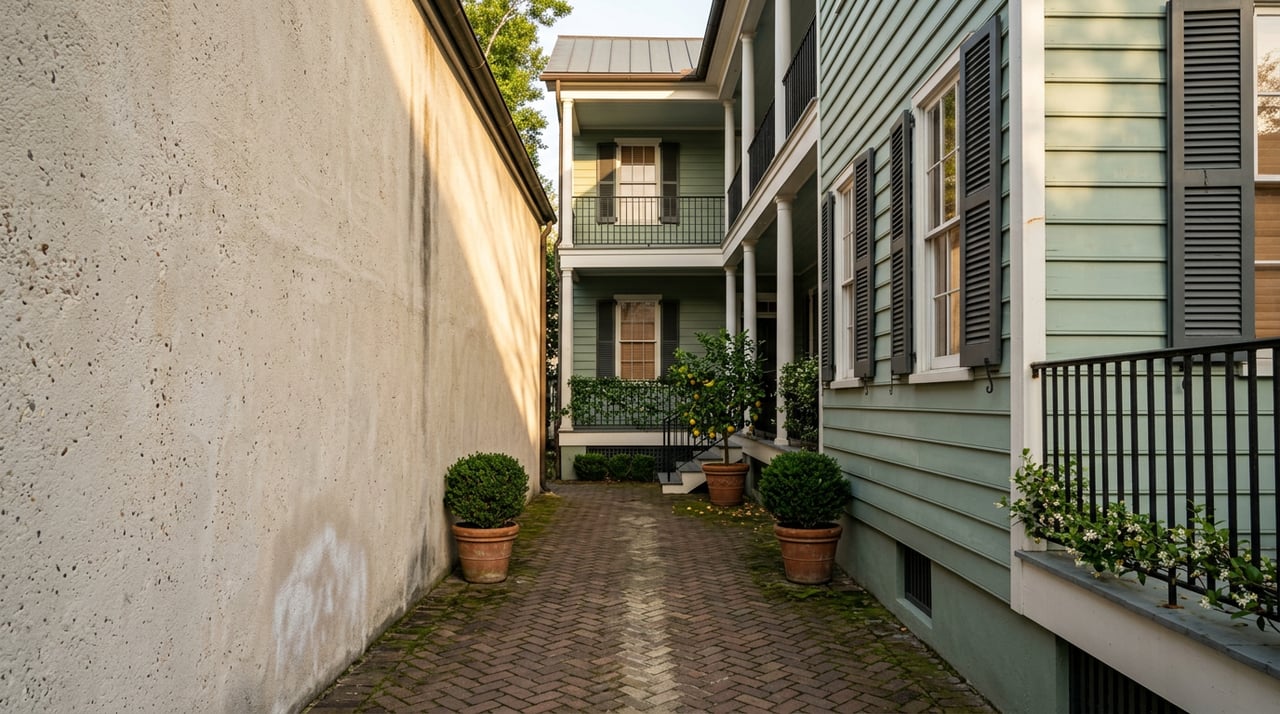
A median works as a market signal when enough transactions feed it. When a neighborhood only closes a handful of sales in a given stretch, one or two trophy properties can swing the reported number by hundreds of thousands of dollars without any real shift in buyer appetite underneath. South of Broad is a small, fixed footprint at the tip of the peninsula, bounded by Broad Street to the north and water on the other three sides. There is no adjacent land to develop into it and almost nothing left to build from scratch inside it. When the transaction pool is that thin, a single high-dollar closing does the work that dozens of ordinary sales would do in a larger market.
That is the mechanism behind the 60.7 percent figure. It is not a citywide trend compressed into one neighborhood. It is what happens when you measure a market with an unusually small sample size and treat the result like it describes broad demand.
The rule that keeps South of Broad from absorbing that demand
The reason South of Broad's supply stays this thin is not an accident of the market. It is policy, and it dates back further than most buyers realize. Charleston's Board of Architectural Review was established in 1931 under the country's first preservation ordinance, and it still governs exterior changes visible from the public right of way anywhere inside the city's historic districts. Within that footprint, the Board's own rules require review of any demolition on a building 50 years or older south of Mount Pleasant Street, and of any demolition at all, regardless of the building's age, once it falls inside the Old and Historic District. The National Park Service counts more than 1,400 historically significant buildings on the peninsula that fall under some form of this review.
Height restrictions compound the effect. The Preservation Society of Charleston notes that Fort Sumter House, a former hotel converted to condominiums, is the only high-rise structure allowed to exist in South of Broad, a direct result of the district's height limits. You cannot add supply by building up, and you cannot add supply by tearing down and starting over. What is standing today is close to what will be standing in five years, which means every buyer competing for the small number of homes that do trade is competing for a fixed and shrinking pool.
That same building, oddly enough, is where South of Broad's price story gets more interesting. Condo units at Fort Sumter House have sold for between $387,000 and $1.225 million since 2020. So the neighborhood's ultra-high median coexists with a genuine, much lower entry point, just not in the single-family stock that dominates the headline number. If you only look at the median, you miss that South of Broad actually contains two very different markets stacked on top of each other.
What the rest of the peninsula shows you instead
Move a few blocks north into Cannonborough-Elliotborough and the picture changes, even though you are still on the same peninsula, still walking distance from King Street, still surrounded by nineteenth-century architecture. The neighborhood's median sale price over the trailing twelve months sat close to $1.25 million, up roughly 25 percent from the year before. That is real appreciation, but it is appreciation happening in a market where more homes actually change hands, which makes the number a more honest reflection of demand than South of Broad's swing.
Here is a rough comparison of what the peninsula's price tiers actually look like right now:
| Peninsula Area | Recent Median Sale Price | Reported YoY Change | Why |
|---|---|---|---|
| South of Broad | $3.495 million (March 2026) | +60.7% | Thin transaction pool, near-zero new supply, trophy sales dominate the number |
| Cannonborough-Elliotborough | ~$1.25 million (trailing 12 months) | +25% | More turnover, mixed historic designations, smaller lots and units in the mix |
| Charleston citywide | $680,000 (March 2026) | — | Broader city inventory spanning historic and non-historic construction alike |
The gap between rows one and two is not fully explained by location. Cannonborough-Elliotborough carries a different, generally less restrictive layer of historic designation on many of its parcels than the Old and Historic District designation that covers most of South of Broad, and that difference in review intensity shows up in how often properties there actually sell.
A new rule most buyers have not heard about yet
The city is not loosening any of this. On March 5, 2026, Board of Architectural Review staff introduced a new Opt-In option for the Historic Materials Demolition District covering the area north of Line Street, walking property owners through how the opt-in review works and how it changes the way the Board evaluates a building. If you are shopping north of Line Street on the assumption that you have more renovation flexibility there than you would South of Broad, that assumption is getting less reliable by the month. The city is actively extending review into corridors that used to carry lighter oversight.
Even for owners who already know they need Board approval, the process itself has a queue. BAR-Large meetings are capped at eight agenda items and BAR-Small meetings at fifteen. As recently as July 2026, demand for those slots outpaced that capacity: the BAR-Small agenda for July 9 filled before its deadline, pushing new applicants to the next available meeting on July 23, which carried its own submission cutoff of noon on July 6. If your purchase plans depend on a specific renovation getting approved on a specific timeline, budget for the possibility that the calendar, not the design, is what actually holds you up.
The paperwork that outlives the sale
Board approval is not the only layer. Historic Charleston Foundation currently holds more than 400 preservation easements and covenants across the city and Lowcountry, with a new easement recorded on Pitt Street as recently as January 2026. An easement is a separate, recorded legal agreement that can restrict alterations to a property's exterior, and in some cases its interior, well beyond what BAR review covers on its own. It survives the sale. It binds whoever buys the house next, and it can require a written sign-off from the easement holder in addition to Board approval before certain work can proceed.
This is also why South Carolina sellers on the peninsula are expected to disclose whether a property falls under BAR jurisdiction and whether it carries any pending or past BAR applications. That disclosure only covers Board review. It says nothing about whether an easement holder has a separate approval right buried in a document from decades earlier. Before you get attached to a floor plan you intend to change, ask whether the property carries a recorded easement and, if so, who holds it.
What this means if you are comparing neighborhoods
The headline number tells you that South of Broad got dramatically more expensive. What it actually shows is a neighborhood where supply cannot expand no matter how demand behaves, where a single sale can move the median by six figures, and where two very different markets, mansion and condo conversion, get folded into one statistic. Cannonborough-Elliotborough's more moderate, more frequently traded appreciation is arguably the more trustworthy read on where peninsula demand is actually heading.
None of this means South of Broad is a bad place to buy. It means the price you see is not describing the market the way it would in a neighborhood with normal turnover, and the rules that shape that scarcity, the Board's review authority, the height limits, the new opt-in demolition district, the easements that outlast a closing, are the parts of the transaction that determine what you can actually do with the house once you own it.
FAQ
Does BAR approval cover changes to the inside of a historic home? Generally no. The Board primarily reviews exterior work visible from the public right of way. Interior changes typically fall outside its purview unless the property carries a separate preservation easement that specifically extends to interior features.
If I buy a home with a preservation easement, do I have to honor it? Yes. An easement is a recorded legal agreement that binds current and future owners, not just the person who granted it. Request the recorded document during due diligence and contact the named holder before assuming any renovation is possible.
Is the price surge happening the same way across the whole historic peninsula? No. The mechanism behind South of Broad's jump, a small number of trophy sales in a supply-locked footprint, does not apply evenly elsewhere. Neighborhoods with more frequent turnover and less restrictive historic designations show steadier, more moderate appreciation.
Comparing what a historic Charleston address actually lets you do, not just what it costs, is the kind of groundwork that shapes a good offer long before it reaches a closing table. If you are weighing South of Broad against the rest of the peninsula, or the peninsula against Mount Pleasant and the barrier islands, St. Germain Properties can walk you through the Board history, the easements, and the off-market inventory that never reaches a portal search. Request a Private Consultation to start that conversation.